artemfinallymadeit
#Mobile
#Product
#UX
#UI
Home cleaning app designed to digitize cleaning services in a fully analog market, from research to a development-ready MVP
001
Context
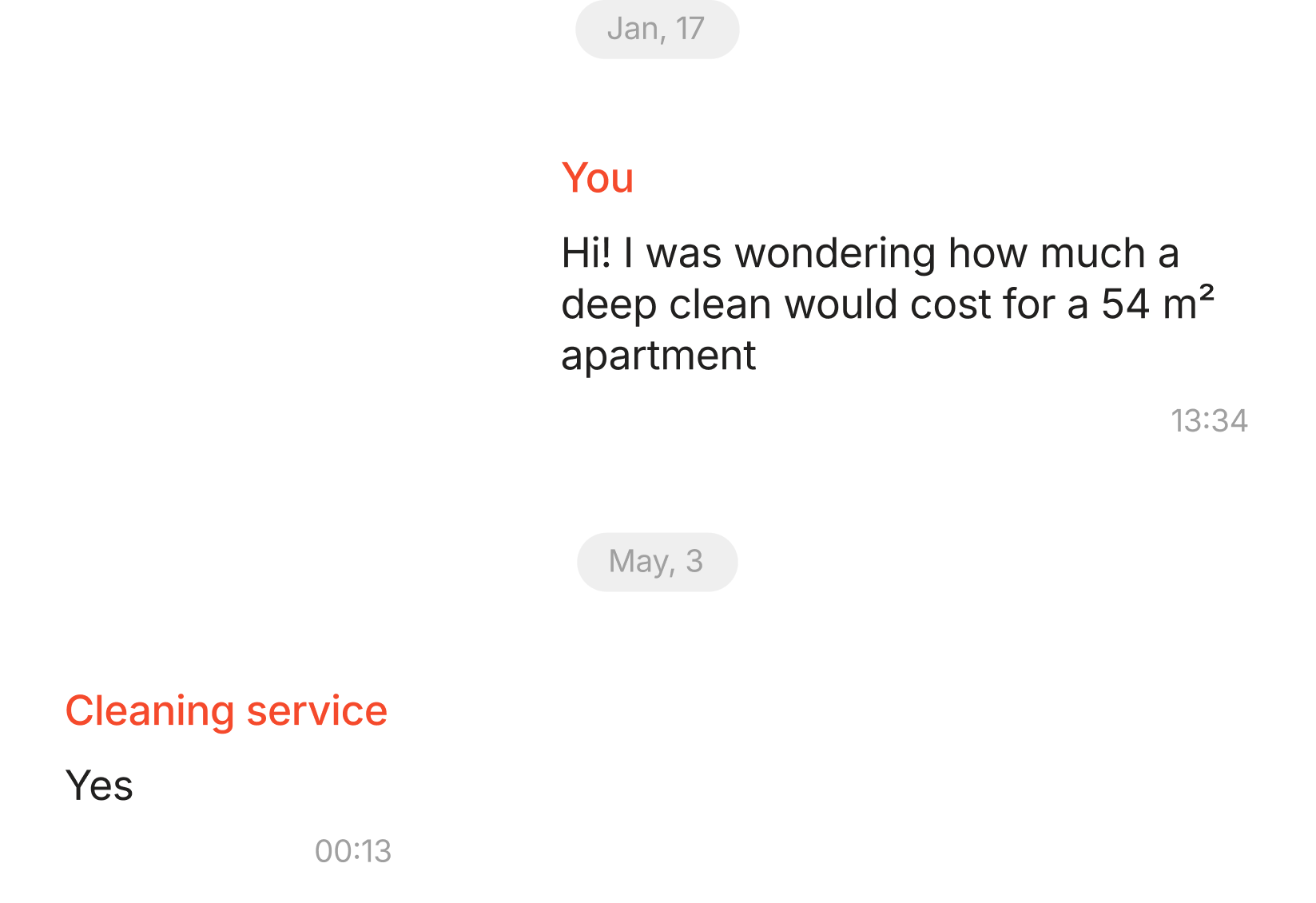
Most cleaning bookings in the country are still made by phone or message, making the process slow and opaque
002
Research
For a better understanding of the local market, research covering local cleaning services and the global cleaning industry was conducted
— Global market overview, industry trends and growth potential
— Public reviews and social media comments
— Interviews with 20 cleaning service customers
— Calls to 30 local cleaning companies about services and pricing
— Interviews with 10 cleaners
003
Key findings and pain points
The research revealed recurring problems on both sides of the service
At the same time, the global market overview pointed to continued industry growth and long-term potential. Locally, most companies were fully booked three to five days in advance, indicating strong demand for cleaning services
Customer side:
1 / 4
Inconvenient booking process
Most cleaning services are booked by phone, through messages or on social media. After calling, customers are often asked to send the details again via a messaging app but may never receive a response. In roughly half of the cases, companies promise to call back but do not
2 / 4
Unclear service scope and pricing
Different cleaning types have no fixed task lists or clear pricing for additional services. Customers cannot see exactly what is included before booking, and the final price may differ from the initial quote
3 / 4
Low trust and accountability
Many cleanings are carried out without clear agreements or documentation, making it unclear who is accountable. If property is damaged or something goes missing, customers often have no clear way to resolve the issue
4 / 4
Last-minute cancellations
A cleaner may cancel shortly before the scheduled time or simply fail to show up, leaving the customer without the service or a quick replacement
Cleaner side:
1 / 2
Inefficient workflow
Schedules are managed manually and often change at the last minute. Cleanings are assigned without always accounting for the cleaner’s location or current workload, while cleaners have little choice over which jobs they take
2 / 2
Unclear payouts
Cleaners do not always understand how their earnings are calculated or why deductions are applied
004
Benchmarking
Since there are no mature digital home-cleaning platforms in the region to benchmark against, the research focused on global leaders in home cleaning and on-demand services to define a product baseline, identify proven UX patterns, and adapt relevant solutions to the local market context
Mobile-first booking
Time-slot scheduling
Flat-rate pricing upfront
Add-ons during booking
Standardised service scope
Quality guarantee
Verified cleaners
Cancellation policies & fees
Real-time order management
Handy
V
V
V
V
V
V
V
V
V
Helpling
V
V
—
—
—
V
V
V
V
Housekeep
V
V
V
V
—
V
V
V
V
TaskRabbit
V
—
—
—
—
—
—
V
—
Urban Company
V
V
V
V
V
V
V
V
V
005
Goal
Based on the research findings, the goal was to turn a fragmented manual process into a structured digital product that would make the cleaning experience faster, more transparent and more predictable for both customers and cleaners

006
Product structure
The product was structured into three connected parts covering every stage of the service
1 / 3
Customer app
Booking, payments, cleaning tracking
2 / 3
Operational layer
Pricing, order allocation, payouts
3 / 3
Cleaner app
Availability, available cleanings, checklists, earnings
007
Booking process
Booking was reduced to a four-step digital flow with clear service options and upfront pricing, replacing calls and messages
008
Trust and accountability
Booking a home cleaning means giving someone access to a private space. The product therefore needed to show that cleaners were verified professionals and make the service feel less anonymous
Cleaner verification and persistent order records give the support team a clear basis for handling disputes
009
Reducing last-minute cancellations
To reduce last-minute cancellations from both cleaners and customers, a cancellation fee system was introduced for both sides of the service
The hypothesis was that cancellation fees would discourage last-minute cancellations and no-shows. If a cleaner cancels, the order returns to the open-order pool and is prioritised for cleaners whose availability matches the booking. Once a replacement accepts it, the new cleaner appears in the customer’s existing booking
010
Digitising the cleaner workflow
The cleaner app replaces manual coordination with a digital workflow for planning availability, reviewing available cleanings and managing cleanings from acceptance to completion
011
Earnings transparency
The financial flow shows the cleaner’s earnings for each order and how the final payout is calculated
#Web
#Creative
#Mobile
#Brand
#Product
#UX
#UI
012
Outcome
The research findings were translated into a complete product design covering the customer and cleaner apps. The final deliverables also included naming, a logo and a reusable design system. The product entered development but was discontinued before launch, which is sad
artemfinallymadeit
#Mobile
#Product
#UX
#UI
Home cleaning app designed to digitize cleaning services in a fully analog market, from research to a development-ready MVP
001
Context
Most cleaning bookings in the country are still made by phone or message, making the process slow and opaque
002
Research
For a better understanding of the local market, research covering local cleaning services and the global cleaning industry was conducted
— Global market overview, industry trends and growth potential
— Public reviews and social media comments
— Interviews with 20 cleaning service customers
— Calls to 30 local cleaning companies about services and pricing
— Interviews with 10 cleaners
003
Key findings and pain points
The research revealed recurring problems on both sides of the service
At the same time, the global market overview pointed to continued industry growth and long-term potential. Locally, most companies were fully booked three to five days in advance, indicating strong demand for cleaning services
Customer side:
1 / 4
Inconvenient booking process
Most cleaning services are booked by phone, through messages or on social media. After calling, customers are often asked to send the details again via a messaging app but may never receive a response. In roughly half of the cases, companies promise to call back but do not
2 / 4
Unclear service scope and pricing
Different cleaning types have no fixed task lists or clear pricing for additional services. Customers cannot see exactly what is included before booking, and the final price may differ from the initial quote
3 / 4
Low trust and accountability
Many cleanings are carried out without clear agreements or documentation, making it unclear who is accountable. If property is damaged or something goes missing, customers often have no clear way to resolve the issue
4 / 4
Last-minute cancellations
A cleaner may cancel shortly before the scheduled time or simply fail to show up, leaving the customer without the service or a quick replacement
Cleaner side:
1 / 2
Inefficient workflow
Schedules are managed manually and often change at the last minute. Cleanings are assigned without always accounting for the cleaner’s location or current workload, while cleaners have little choice over which jobs they take
2 / 2
Unclear payouts
Cleaners do not always understand how their earnings are calculated or why deductions are applied
004
Benchmarking
Since there are no mature digital home-cleaning platforms in the region to benchmark against, the research focused on global leaders in home cleaning and on-demand services to define a product baseline, identify proven UX patterns, and adapt relevant solutions to the local market context
Mobile-first booking
Time-slot scheduling
Flat-rate pricing upfront
Add-ons during booking
Standardised service scope
Quality guarantee
Verified cleaners
Cancellation policies & fees
Real-time order management
Handy
V
V
V
V
V
V
V
V
V
Helpling
V
V
—
—
—
V
V
V
V
Housekeep
V
V
V
V
—
V
V
V
V
TaskRabbit
V
—
—
—
—
—
—
V
—
Urban Company
V
V
V
V
V
V
V
V
V
005
Goal
Based on the research findings, the goal was to turn a fragmented manual process into a structured digital product that would make the cleaning experience faster, more transparent and more predictable for both customers and cleaners
006
Product structure
The product was structured into three connected parts covering every stage of the service
1 / 3
Customer app
Booking, payments, cleaning tracking
2 / 3
Operational layer
Pricing, order allocation, payouts
3 / 3
Cleaner app
Availability, available cleanings, checklists, earnings
007
Booking process
Booking was reduced to a four-step digital flow with clear service options and upfront pricing, replacing calls and messages
008
Trust and accountability
Booking a home cleaning means giving someone access to a private space. The product therefore needed to show that cleaners were verified professionals and make the service feel less anonymous
Cleaner verification and persistent order records give the support team a clear basis for handling disputes
009
Reducing last-minute cancellations
To reduce last-minute cancellations from both cleaners and customers, a cancellation fee system was introduced for both sides of the service
The hypothesis was that cancellation fees would discourage last-minute cancellations and no-shows. If a cleaner cancels, the order returns to the open-order pool and is prioritised for cleaners whose availability matches the booking. Once a replacement accepts it, the new cleaner appears in the customer’s existing booking
010
Digitising the cleaner workflow
The cleaner app replaces manual coordination with a digital workflow for planning availability, reviewing available cleanings and managing cleanings from acceptance to completion
011
Earnings transparency
The financial flow shows the cleaner’s earnings for each order and how the final payout is calculated
#Web
#Creative
#Mobile
#Brand
#Product
#UX
#UI
012
Outcome
The research findings were translated into a complete product design covering the customer and cleaner apps. The final deliverables also included naming, a logo and a reusable design system. The product entered development but was discontinued before launch, which is sad
artemfinallymadeit
#Mobile
#Product
#UX
#UI
Home cleaning app designed to digitize cleaning services in a fully analog market, from research to a development-ready MVP
001
Context
Most cleaning bookings in the country are still made by phone or message, making the process slow and opaque
002
Research
For a better understanding of the local market, research covering local cleaning services and the global cleaning industry was conducted
— Global market overview, industry trends and growth potential
— Public reviews and social media comments
— Interviews with 20 cleaning service customers
— Calls to 30 local cleaning companies about services and pricing
— Interviews with 10 cleaners
003
Key findings and pain points
The research revealed recurring problems on both sides of the service
At the same time, the global market overview pointed to continued industry growth and long-term potential. Locally, most companies were fully booked three to five days in advance, indicating strong demand for cleaning services
Customer side:
1 / 4
Inconvenient booking process
Most cleaning services are booked by phone, through messages or on social media. After calling, customers are often asked to send the details again via a messaging app but may never receive a response. In roughly half of the cases, companies promise to call back but do not
2 / 4
Unclear service scope and pricing
Different cleaning types have no fixed task lists or clear pricing for additional services. Customers cannot see exactly what is included before booking, and the final price may differ from the initial quote
3 / 4
Low trust and accountability
Many cleanings are carried out without clear agreements or documentation, making it unclear who is accountable. If property is damaged or something goes missing, customers often have no clear way to resolve the issue
4 / 4
Last-minute cancellations
A cleaner may cancel shortly before the scheduled time or simply fail to show up, leaving the customer without the service or a quick replacement
Cleaner side:
1 / 2
Inefficient workflow
Schedules are managed manually and often change at the last minute. Cleanings are assigned without always accounting for the cleaner’s location or current workload, while cleaners have little choice over which jobs they take
2 / 2
Unclear payouts
Cleaners do not always understand how their earnings are calculated or why deductions are applied
004
Benchmarking
Since there are no mature digital home-cleaning platforms in the region to benchmark against, the research focused on global leaders in home cleaning and on-demand services to define a product baseline, identify proven UX patterns, and adapt relevant solutions to the local market context
Mobile-first booking
Time-slot scheduling
Flat-rate pricing upfront
Add-ons during booking
Standardised service scope
Quality guarantee
Verified cleaners
Cancellation policies & fees
Real-time order management
Handy
V
V
V
V
V
V
V
V
V
Helpling
V
V
—
—
—
V
V
V
V
Housekeep
V
V
V
V
—
V
V
V
V
TaskRabbit
V
—
—
—
—
—
—
V
—
Urban Company
V
V
V
V
V
V
V
V
V
005
Goal
Based on the research findings, the goal was to turn a fragmented manual process into a structured digital product that would make the cleaning experience faster, more transparent and more predictable for both customers and cleaners
006
Product structure
The product was structured into three connected parts covering every stage of the service
1 / 3
Customer app
Booking, payments, cleaning tracking
2 / 3
Operational layer
Pricing, order allocation, payouts
3 / 3
Cleaner app
Availability, available cleanings, checklists, earnings
007
Booking process
Booking was reduced to a four-step digital flow with clear service options and upfront pricing, replacing calls and messages
008
Trust and accountability
Booking a home cleaning means giving someone access to a private space. The product therefore needed to show that cleaners were verified professionals and make the service feel less anonymous
Cleaner verification and persistent order records give the support team a clear basis for handling disputes
009
Reducing last-minute cancellations
To reduce last-minute cancellations from both cleaners and customers, a cancellation fee system was introduced for both sides of the service
The hypothesis was that cancellation fees would discourage last-minute cancellations and no-shows. If a cleaner cancels, the order returns to the open-order pool and is prioritised for cleaners whose availability matches the booking. Once a replacement accepts it, the new cleaner appears in the customer’s existing booking
010
Digitising the cleaner workflow
The cleaner app replaces manual coordination with a digital workflow for planning availability, reviewing available cleanings and managing cleanings from acceptance to completion
011
Earnings transparency
The financial flow shows the cleaner’s earnings for each order and how the final payout is calculated
#Web
#Creative
#Mobile
#Brand
#Product
#UX
#UI
012
Outcome
The research findings were translated into a complete product design covering the customer and cleaner apps. The final deliverables also included naming, a logo and a reusable design system. The product entered development but was discontinued before launch, which is sad